
Summary of Programme:
1st place at the final competition of the Optiver & Imperial Trading Academy!
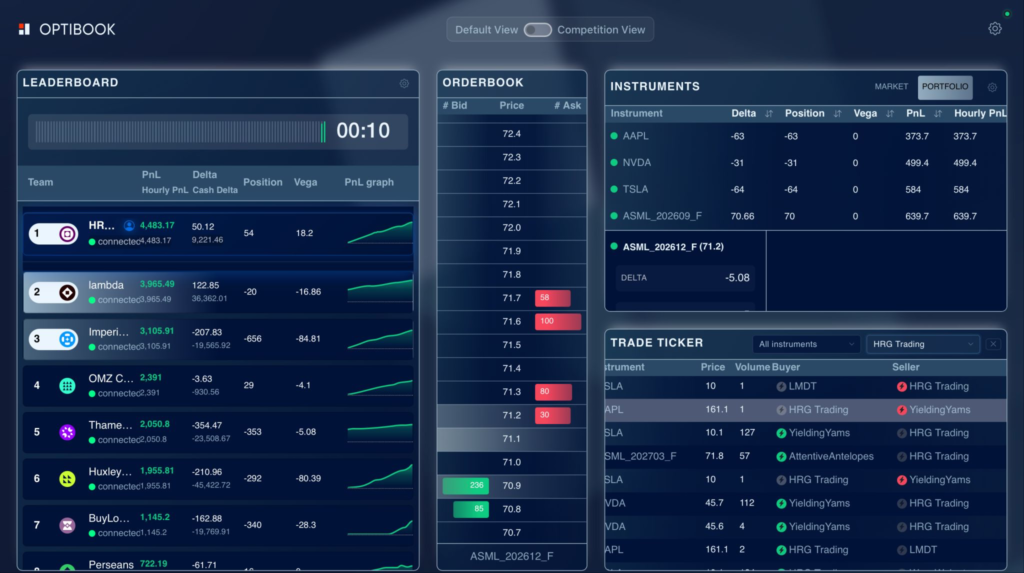
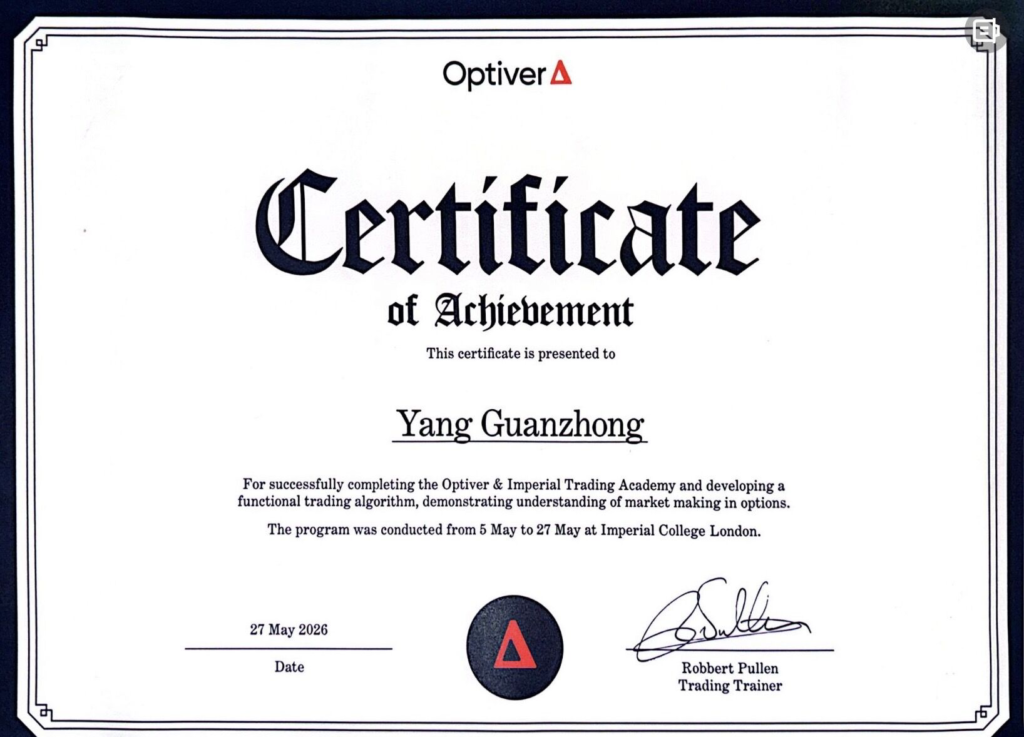
After a month of intensive training, 16-hour lectures, and countless lines of code, I’m proud to share that I completed the Optiver & Imperial College London Trading Academy yesterday. Together with my teammates Hiten Umarnani and Royce De Asis, I placed 1st in the final quantitative algorithmic trading competition out of 80 participants, and we have been invited to visit Optiver’s London headquarters.
Under Robbert Pullen’s guidance, the academy gave me a structured introduction to how systematic market makers price, quote, hedge, and manage risk across related instruments. We moved from core market microstructure concepts — such as order book dynamics, liquidity provision, execution priority, and order types — to cross-asset pricing relationships in the index complex, including dual listings, stock–future carry pricing, ETF–future valuation, and option pricing and hedging. What stood out most was the way these concepts were framed not as isolated theories, but as components of a coherent market-making framework.
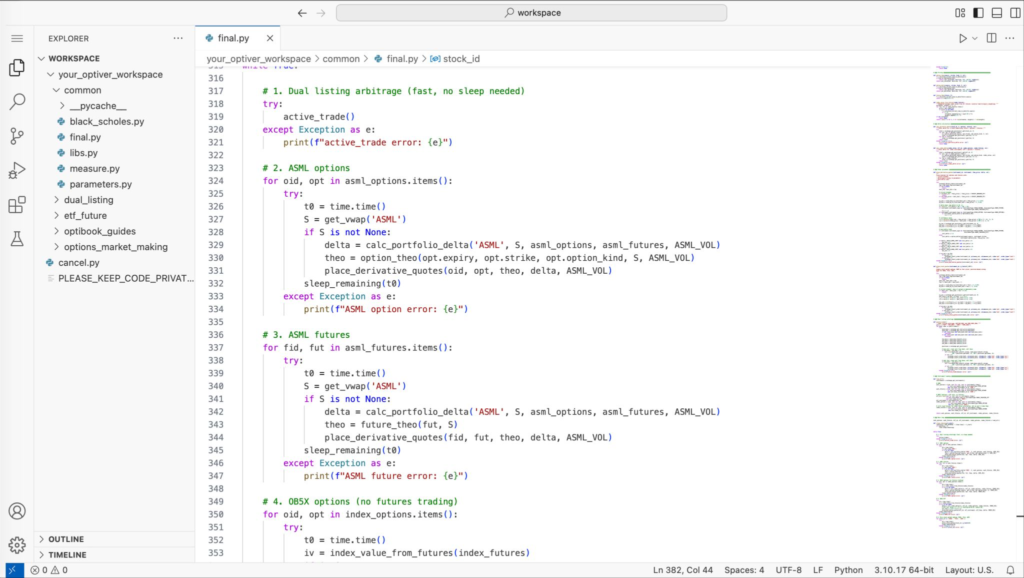
For the final competition, we translated these ideas into a live trading algorithm and refined it through repeated testing and debugging on Optibook. The core architecture of our final algorithm combines:
1. Black-Scholes theoretical pricing for options and no-arbitrage carry pricing for futures, anchored against volume-weighted order book data
2. A delta-aware quoting engine that dynamically adjusts bid/ask volumes based on real-time portfolio Greeks, with a normalised inventory skew parameter mapping total delta exposure to order sizing
3. A multi-source index valuation model using inverse-time-to-expiry weighted futures prices to derive robust index fair values for ETF and index option pricing
4. Circuit breakers that halt quoting when market prices deviate beyond calibrated thresholds from theoretical values, protecting against stale or manipulated order books at session boundaries
5. Hard per-underlying delta limits that block directional orders before exchange-imposed risk limits are breached, avoiding forced liquidation penalties
After many iterations, this approach proved highly effective: in the final 10-minute competition, our algorithm generated 4500+ PnL, which secured 1st place.
More than the result itself, this experience was valuable because it allowed me to connect theory with implementation. It was my first opportunity to study market making in a structured way, and then immediately test ideas in a live simulated exchange environment by building and improving trading algorithms in real time. That combination of quantitative reasoning, engineering, and rapid experimentation made the academy a genuinely rare learning experience.
Grateful to Optiver and Imperial College London for this opportunity — and to my teammates for the collaboration throughout the competition.
Screenshot for Document 1:

Screenshot for Document 2:
https://github.com/ECFDPB/2026-Optiver-and-Imperial-Trading-Academy